The Sports Journal #60
21-01-2026



SPORTS JOURNAL – A NEW CHAPTER
The Sports Journal is evolving once again — and everything suggests this will be the biggest reform in its history. First and foremost, we are moving away from the previous format of a single news post containing multiple articles. Instead, we’re taking a step toward greater freedom, timeliness, and real community involvement.
The Sports Journal now has its permanent home on the FootballTeam Discord — in a dedicated section operating as an article-based forum. This is where new texts, analyses, and opinions will be published, created by players, for players.
We know many of you are interested in how compensation will work, so let’s make this clear. The best and most valuable articles will be rewarded — with prizes of up to 20,000 Credits. However, payment is not guaranteed upfront. All articles will be reviewed, and those that truly deserve it will be selected by the community through voting. This ensures that rewards go to authors whose work stands out in quality, creativity, and substantive value.
Most importantly — from now on, every player can write an article. No special journalist rank is required. If you have something interesting to say about FootballTeam, leagues, clubs, events, or the community — this place is for you. More information coming soon.
We invite you to help us create the new Sports Journal 💙
TABLE OF CONTENTS
1/ FOOTBALL TEAM: THE AGE OF BALANCE
3/ JANUARY STARTER BUNDLES AND THE NEW PROGRESSION STRATEGY IN FOOTBALLTEAM
4/ OVERWHELMING IN THE FOOTBALLTEAM WORLD?
6/ MARKET PRICES… HIGH PRICES - YES OR NO?
7/ REFEREEING CONTROVERSY THROUGH THE EYES OF THE MANAGER #28
FOOTBALL TEAM: THE AGE OF BALANCE
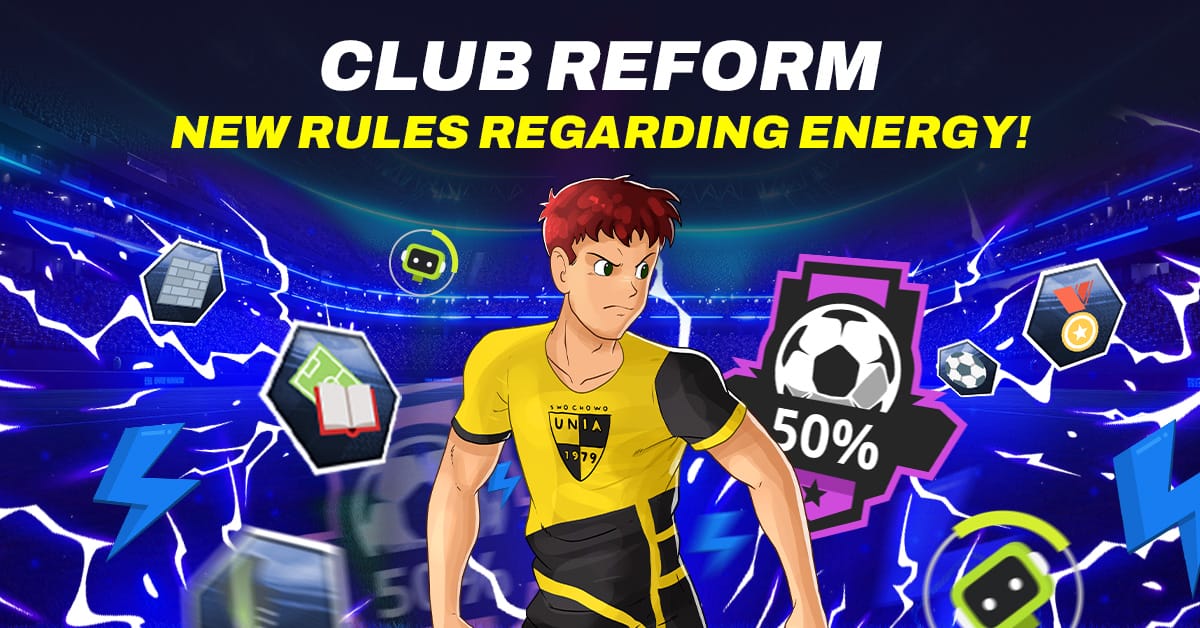
Special Edition: Club Reform and the Revolution in Training Energy
The FootballTeam landscape is about to change dramatically. Management has announced a profound reform of the management system..
THE END OF MONOPOLIES: THE CLUB'S NEW REFORM
For years, the community has pointed to a chronic problem: the excessive concentration of talent. When one or two Clubs absorb all the best players….
The new reform does not prohibit the hiring of star players, but introduces the concept of "Quality Pricing". Instead of rigid barriers (such as OVR limits), the system They pay a strategic price for having star-studded squads.
What Changes for You?
Freedom with Responsibility: You can still play wherever you want, but clubs will need to plan better and.
More Opportunities: High-level players tend to spread across more clubs to avoid exorbitant costs, opening up job opportunities in various areas..
Emphasizing Planning: Success will now come from intelligent management, not just from bringing the largest OVRs together in one place..
The new energy calculation: How does it work in practice?
The major technical change lies in the Energy Cost in Training. The system now monitors the ranking of the 30 best trained skills within each club..
The Golden Rule
The cost of training will increase proportionally if a club has more than two players in the top 30 of the server's skill ranking.
Practical Example of Savings:
One session costs 10.00.
This means that the financial and resource impact will be felt directly in maintaining the training pace of the superclubs, allowing smaller clubs to "catch up" with the giants through training..
WHY IS THIS GREAT FOR PLAYERS?
This reform was designed with the long-term well-being of the community in mind. Here are the pillars that make this change the best for your future in the game.:
Protection for Small and Medium-Sized Clubs: Growing clubs will no longer simply be "run over." They now have a real chance to compete and attract talent.
Heated Transfer Market: With big clubs limiting their number of "Top Players" to save energy, excellent players will be available..
Recompensa ao Mérito: Ganhar um título agora exigirá coordenação, uso inteligente de itens e estratégia de treino, tornando a vitória muito mais saborosa.
🎤 Editorial Verdict: A Healthy Future
The FootballTeam administration was honest: there is no perfect solution. However, by choosing a path that indirectly forces decentralization, the game.
Get your cleats and your strategy ready: the new season promises to be the most balanced in the history of the Football Team!
Author: Kai Havertz
WHAT IF #5
Imagine: the year 2030. FootballTeam still exists, but it's not the same game where you click "training" and go to sleep. Now your player is leading a real football career, scoring goals in 3D, and each match is a series of unpredictable adventures – from virtual trampolines, to a shower of lollipops, to mini-rainbows after goals. In short: football like never before, full of laughter, absurdity, and crazy situations that leave you unsure whether you're playing a and glowing socks when scoring. Each player will have a unique look, and matches will resemble a cross between football and a superhero cartoon.
Truly unpredictable weather?
What if colorful lollipops suddenly started raining down on the pitch, and players had to dodge the candy to avoid losing the ball? What if the wind suddenly tossed players into the air, turning every sprint into a cartoon-like pirouette? Maybe fog would appear in the shapes of hearts, cats, and balls, with players running through it trying to find the ball while fans burst into laughter. What if after every goal, confetti rained down from the sky and the ball bounced off mini rainbows in unpredictable ways, creating even more spectacular plays? Or perhaps sometimes the pitch would turn into a light trampoline, and players would leap into the air like superheroes with every touch of the ball? The possibilities would be endless, and every match would become a comedic adventure where the ball, the players, and the weather come together to create a spectacle full of laughter and surprises.
Matches played in 3D?
No more text-based "90' GOOOL!!!"
Now you start a match, and your player is actually running around the pitch. The AI commentator shouts, "Great pass! Too bad it went to the opponent!" – and you watch as your character trips over his own boots, giving you a +7 bonus. During penalties, you have to choose which way to shoot, if you choose wrongly, you lose.
The ability to talk during a match via voice chat?
– Activate engagement, you unintelligent teammates!
– I can't, I'm lagging!
– XD
After 10 minutes, a team gets banned for "too realistic a representation of sporting emotions."
The stadium of the future?
Clubs in 2030 have their own interactive stadiums. Each player can design their own fan section, change the colors of the stands, and set lighting effects for goals. Furthermore, there are mini modes for the audience: fans can, for example, vote on which kits the players will wear in the next match or choose which tactics will be tested in a training friendly. They also have the option to pelt players with tomatoes or throw a banana peel at an opponent while running. I have a feeling that only then would the voice chat explode.
Stylish uniforms and equipment:
Customization in 2030 has gone completely insane. Players can design their own boots, jerseys, and shin guards with glowing stars, speech bubbles, and mini confetti explosions when they score. Each player looks like a sports cartoon character, and your goals are remembered not only in the standings but also on a visual style map. Some players wear hats instead of caps, others change their hair color every hour, because why not? The uniforms will feature special effects: wings when running, capes that blow opponents away, What if it suddenly started raining colorful lollipops on the pitch, and players had to dodge the candy to avoid losing the ball? What if the wind suddenly knocked players in the air, making every sprint a cartoonish pirouette? Perhaps the fog would appear in the shape of hearts, cats, and balls, and players would run through it, trying to find the ball while the fans burst into laughter. What if, after every goal, confetti rained down from the sky, and the ball bounced off a mini rainbow in unpredictable patterns, creating spectacular action sequences? Or perhaps the pitch would sometimes become a light trampoline, and players would leap into the air like superheroes with every touch? The possibilities would be endless, and every match would turn into a comedic adventure, where the ball, the players, and the weather combined to create a spectacle full of laughter and surprises.
Discord:
Of course, we can't forget about Discord, which could be ruled by AI, but we can be sure of one thing: the Byk z Pampeluny has probably already received his 15th permanent ban! (Oh, I have a feeling I might start looking for a new club, lol).
Getting back to the topic, there would probably be many more events on Discord, and it wouldn't be possible for players to participate in all of them, yet there would still be a few people, like Simon, who would manage! Moderators wouldn't be needed, because the AI would take over all their duties.
Summary:
Is this vision of gaming in 2030 realistic? Let's be honest, it's as realistic as Simon saying he's rich (very little). I hope I managed to cheer you up. If you have a topic you'd like me to cover (tongue in cheek, of course), feel free to leave it in the comments.
Author: Gruby Tymek
JANUARY STARTER BUNDLES AND THE NEW PROGRESSION STRATEGY IN FOOTBALLTEAM
FootballTeam begins the new year with a noticetrong visual themes, flashy characters, and bold messages such as “Buy Now,” “Get Them Now,” or “Double Drop.” These offers often featured high percentage bonuses, sometimes reaching up to 200% value, and were designed to create urgency. Their impact was immediate but short-lived, concentrated around specific calendar dates.
In previous months, bundles were strongly tied to time-limited events. Halloween, Black Friday, and Black Week bundles were built around bold visual themes, striking characters, and catchy calls to action such as “Buy now,” “Get it now,” or “Double Drop.” These offers often included high percentage bonuses, reaching up to 200% value, and were designed to create a strong sense of urgency. Their impact was immediate but short-lived, focused around specific calendar dates.
The January Starter Bundles follow a different philosophy. Instead of focusing solely on urgency, they emphasize long-term advantages and early-season development. These packs include significant energy resources, training boosts, XP drinks, cost reductions in both euros and energy, and scalable bonuses that increase with higher-tier bundles. The message is clear: starting the year strong means accelerating your player’s growth from the very beginning.
From a communication standpoint, the difference is also evident. Older event bundles relied on minimal explanations and emotional triggers, while the January bundles provide clearer descriptions of what players receive and how those benefits influence progression. The reminder that “the bigger the bundle you choose, the more you gain” reinforces a strategy of planned investment rather than impulse buying.
In terms of gameplay impact, this shift directly affects the pace at which players develop. Managers who invest in the January Starter Bundles can train more frequently, spend less energy, and reduce overall costs. This leads to faster attribute growth and a stronger competitive position in leagues and key matches. In contrast, older bundles often provided short-term boosts, usually focused on credits or specific drops, without necessarily improving daily efficiency.
Naturally, the community response has been mixed. Some players welcome the new bundles as a fair opportunity to begin the year on equal footing, especially after periods with fewer impactful events. Others express concern that these packs widen the gap between paying and non-paying players, intensifying the long-standing pay-to-progress debate. While this discussion already existed during previous events, it becomes more pronounced when bundles directly affect everyday performance rather than isolated moments.
Another important aspect is visibility. Event bundles in the past appeared temporarily and disappeared once the event ended. The January Starter Bundles, however, occupy a prominent place in the news section at the very start of the year. This suggests a more permanent role for this type of offer, potentially signaling a new direction for FootballTeam’s seasonal structure and monetization strategy.
Despite criticisms, the new bundles are undeniably well-structured. Unlike some older packs that relied heavily on chance or unpredictable drops, the January bundles offer clear, guaranteed benefits. This transparency appeals to players who prioritize planning, efficiency, and long-term development over luck-based rewards.
In conclusion, comparing the older event-based bundles with the new January Starter Bundles highlights a significant evolution in FootballTeam’s internal economy. The game is moving away from purely seasonal promotions toward packages that shape early-season progression. The challenge going forward will be maintaining balance between monetization, competitiveness, and community satisfaction, ensuring that progress remains driven by strategy and dedication rather than purchases alone.
Author: Kai Havertz
OVERWHELMING IN THE FOOTBALLTEAM WORLD?
Have the Games become a daily occurrence instead of a celebration?
In recent weeks, the FootballTeam community has observed an increase in events like the "Games." The situation where the Club and Training Games almost overlap with the newly announced Work Games has sparked a wide debate among players. Is the pace set by the administration sustainable in the long run?
Community Voice: Between Ambition and Exhaustion:
Analyzing the recent comments under updates, it's hard not to notice a growing sense of fatigue. Players who were previously enthusiastic about the competition are starting to point out several key issues:
- Too high pace: Users like jestemurban indicate that with such a high frequency of events, the game is no longer fun and is starting to feel like a chore. The accumulation of three types of games in a short period of time makes players feel overwhelmed by the need for constant activity.
- Barrier to entry for "middle-tier" players: As obunogdc notes, the current format favors the strongest individuals and clubs. Without appropriate compensation mechanisms, smaller players feel their participation in the Games is pointless, as the fight for the top spots is beyond their reach.
- Depleting resources: Comments from Adil Atalay and Prochu shed light on the problem of energy shortages. With such frequent events, supplies gathered over the course of weeks disappear in the blink of an eye, forcing them to constantly buy packages, something not everyone can afford.
Is this a time to reflect on balance?
Many players, such as Baba Yaga and Byk z Pampeluny, have suggested in their comments that they lack a sense of being heard. While the Games are a driving force of competition, too much of them can lead to the phenomenon of "emotion inflation"—when something extraordinary happens all the time, it stops being perceived as a reward and starts as a burden.
It seems the game has reached a point where the community needs a moment of respite to fully appreciate new features.
Proposals for a better future for FootballTeam:
To maintain player engagement while ensuring game dynamics, it's worth considering several solutions that could reconcile the interests of both parties:
1. Segmentation of Games (Divisions):
Introducing Games divided into OVR tiers. This would allow smaller players to compete against each other for rewards appropriate to their level, giving them a real chance at success and motivating them to continue developing.
2. Rotation instead of Stacking:
Instead of running several types of Games simultaneously or consecutively, a better solution would be to rotate them. For example, one week per month is dedicated to Games (alternating between work, training, and club events), which would allow players to better manage their energy and time.
3. "Weeks of Relax":
Introducing periods without ranked events, focused on social mechanics, trading, or lighter challenges that don't require an extreme investment of money and time.
4. Transparent Feedback:
More frequent in-game surveys regarding planned events could calm the mood. Players, feeling that they have a real influence on the competition calendar, would be more understanding towards the administration.
Summary:
FootballTeam is a project with enormous potential and a loyal fan base. The current outcry isn't an attack, but a warning sign from people who care about the game. Finding a balance between monetization and playability will be crucial to ensuring that "The Games" is once again associated with prestige and fun, not just a grueling race.
Author: DaVoS
PLAYERS' GEAR
Hello, welcome to a new edition of the FT Sport Journal, issue #60. This time, the article focuses on the gear players wear. We know that the clothing items used—the jersey, shorts, socks, and boots—are important, but underwear is a great topic for this edition. Obviously, every football player wears this type of garment under their kit, in addition to balls, wristbands, and shin guards, but we've also added undershirts and underwear. I think this type of graphic presentation of gear would be more appropriate for the topic of football. However, this is my personal opinion and is not intended as any kind of criticism of these items.
In today's article, I'd like to think about what other possibilities for football gear exist, what they might look like, and what effects they might have.
I must admit that there are few remaining options regarding football clothing, or perhaps there are none at all. Therefore, in my opinion, two items that currently appear during a traditional football match could be interesting for players.
The first, and probably the most obvious, is the captain's armband. I think this type of item could be a very interesting addition to the game, but in subtly different ways. It could be an item not obtained through training, packs, or by crafting it on the player's account. The captain's armband could be available to every team at no additional cost.
And what would it offer? In my opinion, a player on the team who receives this item in a given match could have a double benefit; they could earn double points or select any number they like, for example, 2-3 points. Someone might say that the team would always choose the strongest player, which is why there should be a limit, for example, that each player can wear the captain's armband in a maximum of 5 matches per season.
Considering the number of matches, each team owner would have to carefully plan the use of this item to avoid running out of options towards the end of the season.
Furthermore, the captain's armband would bring not only benefits but also challenges. Any player wearing the captain's armband would have twice the chance of being fouled, leaving the field due to injury, or receiving a red card. After all, it's not just about winning or securing an advantage over the opponent, but also about being a potential risk.
The captain's armband could be available, for example, at the platinum level and have some upgrade options using resources available in the team's storage. This item would be the first not to be permanently assigned to any player, which would be beneficial for team spirit. In my personal opinion, you shouldn't always rely on individual items, since, after all, this is a team game, and you have to play as a team, or you don't play at all.
Another piece of equipment that appears on real-life playing fields is goalkeeper gloves, which could be used to earn extra points.
In this case, they would obviously be available for goalkeepers in the game, but other items could also be incorporated for other positions, such as headbands for defenders, thermal shirts for midfielders, or special socks for forwards. But let's talk about gloves… thanks to them, the goalkeeper would gain more skills and become a crucial element on the field, allowing them, for example, to prevent goals from free kicks or penalties, which are common these days.
In my opinion, equipment items should be the next step in the game's development, if there are more items in the management's plans, such as incorporating goalkeeper gloves, headbands for defenders, thermal shirts for midfielders, or special socks for forwards—something special for each position in the game, something to distinguish each position. Share your opinions and thoughts in the comments. Would you incorporate other items for your player?
Author: BUFFALO FUNES (ID 1183)
MARKET PRICES… HIGH PRICES - YES OR NO?
Hello everyone, this is Te Quiebro on the Classic server, and I welcome you to issue #60 of the FT Sport Journal. This article is dedicated to the trading of items on the market. Obviously, it's impossible to set a price for all products available on a free market and thus dictate how players should trade. However, for the most expensive, priceless items, drinks, and others, it would be worthwhile to establish some price ranges so that the amount is appropriate to the quality of the product being sold, but also to the level of upgrade in the case of items.
Items that should have such a price range, so that the administration doesn't have to look for potential fraud, are precisely the MID and TOP items, newly created items like underwear or undershirts, whose price should depend on the percentages included in the item itself, and also, above all, the VII drinks for Work and Training, which are undoubtedly a tempting prospect for many traders in the current market, but also for buyers, especially since it's a 1000xp training drink… for those with energy and euro resources, it's a great way to enjoy and quickly increase their OVR; it's one of the most coveted items on the market.
Of course, the price range should be quite wide, so that the player can sell something a little cheaper if they urgently need the Credits, but only slightly more expensive if they want to wait for the right buyer and want to get the most out of the transaction.
In the case of items, the upgrade level should inflate the final price of the product. For example, an item upgraded to level 20+ should have a higher minimum price than one sold at level 0 or, say, level 10-15, which, as we all know, is easier and faster to upgrade, often without the interference of Triumph Balls, which also cost something, not to mention Success Balls, which are dominant at levels 20-25 and above.
Although, currently, the administration trusts the honesty and common sense of the players during transactions, on the other hand, theoretically, it cannot penalize anyone for selling something for more or less than the average market price. After all, the current market is based on personal interpretation, and Support often answers players' questions about the value of a particular item, simply stating that it depends on the market and trusting their honesty. However, the introduction of price tiers should irrevocably resolve this issue for both parties. And it's not about having power over everything that's for sale, but over the most expensive items, which always raise some questions.
Of course, these price ranges should be updated from time to time because, as we know, the market changes rapidly, especially in the case of undershirts. The price of this item fluctuates, but lately it's been slowly falling, mainly because those currently available on the market and their bonuses lack any logic in terms of skills for a given position.
And at this point, it would be good to add that, in this case, there should also be a type of drink or a random option. After all, what's the point of an undershirt with two opposing skills, like offensive and defensive?
That's all from me. Write in the comments what you think about this topic and how much MID and TOP items, undershirts, and underwear should be worth. What should the fair price be, and how much should it increase with upgrades? We look forward to your response! Until the next edition of the sports daily!
AUTHOR: Te Quiebro ID 2754
REFEREEING CONTROVERSY THROUGH THE EYES OF THE MANAGER #28
VAR That Left a Terrible Taste – Analysis of the Polonia Bytom vs. Górnik Łęczna Match:
This next installment in my series on refereeing controversies unfortunately concerns a situation that, instead of being an example of a well-functioning VAR system, leaves a very bad taste in the mouth and raises serious questions about its use. I'm referring to the Polonia Bytom vs. Górnik Łęczna match, where a goal was disallowed to make it 3-2 for the home team after VAR referee Grzegorz Kawałko intervened. The match ended in a 2-2 draw, a decision that directly impacted the match's outcome.
I'm looking at this situation from the perspective of a referee, a coach, and someone who has analyzed similar incidents for years – and I must be clear: this VAR intervention raises grave doubts in my mind, both substantively and procedurally.
81st minute and key moment of the match:
In the 81st minute, Polonia launched a dynamic attack down the left wing. The hosts were on the attack, approaching Górnik's penalty area, when suddenly – just before the penalty spot – Sebastian Szczytniewski fell to the ground.
Moments later, the visiting goalkeeper parried the ball, which Kamil Wojtyra got in to score, making it 3-2. Referee Damian Krumplewski was initially prepared to award the goal, which is significant in itself – meaning he didn't see a foul in person that would have affected the goal.
And that's not a criticism. The referee was observing play on the left wing at that moment, while Wojtyra and Szczytniewski had two touches closer to the center of the pitch, on the right. This is a classic situation where VAR can help – but only if it's done thoroughly and accurately.
The fundamental problem: one camera is not enough:
The VAR referee summoned the referee to the monitor. And here the first, very serious problem arises.
Referee Krumplewski was shown only one shot – from a camera positioned at the starting line of the penalty area. However, the replay from the main, leading camera, positioned centrally in the main stand, was not shown.
It is this second shot – familiar to all viewers of the broadcast – that much better captures the nature of the contact between the players, its sequence, and the possible cause-and-effect relationship between the contact and Szczytniewski's fall.
Showing the referee only one shot, in such an ambiguous situation, is – in my opinion – a serious error in the decision-making process.
Chronology of events: who started it?
Replays clearly show that when the ball was played to the left wing, Szczytniewski was the first to step into Wojtyra's path. It's hard not to get the impression that this was an attempt to block his opponent, slow him down, or even provoke contact away from the ball.
Only in response does Wojtyra move his hand towards Szczytniewski's back. He most likely touches him. And here it's important to be clear: contact itself is not an infringement.
The assessment of such a situation always rests with the referee and depends on:
- the nature of the contact,
- its force,
- the player's intention,
- the impact on subsequent play.
This cannot be measured with a ruler or weighed on a scale. It's a classic interpretation situation.
Did Wojtyra commit a foul?
According to the VAR referee and then the referee, yes. In their opinion, Wojtyra committed a foul that excluded Szczytniewski from the rest of the play and prevented him from effectively continuing the action.
The problem is that there is no indisputable evidence that unequivocally supports such a claim. But equally importantly, there is also no indisputable evidence that Wojtyra actually committed an offense that should have resulted in the goal being disallowed.
And this is absolutely crucial in the context of VAR.
Szczytniewski reaction raises serious doubts:
Looking at this situation repeatedly, I have very serious reservations about the Górnik player's behavior.
Firstly, the fall occurred with a significant delay. It was as if the body's reaction had come too late, as if the decision to fall had been made a second later. In football – especially at the professional level – such delays are very rare.
Secondly, the verbal reaction, namely the loud scream, was clearly disproportionate to the force of the contact. Szczytniewski was able to scream so loudly that it could be heard throughout the stadium, but he allegedly was unable to maintain his balance and continue following the action.
To me, this looks like a conscious attempt to get the referee's attention and force a decision.
VAR and the "clear and obvious error" threshold:
The VAR system should only intervene when there is a clear and obvious error. In this situation, there simply isn't one.
We have:
- two cameras,
- different interpretations,
- a lack of a clear cause-and-effect relationship,
- the player's reaction appears inappropriate.
All of this means that, in my opinion, there were no grounds for disallowing the goal.
How should this situation have been resolved?
In my opinion, the best solution was:
- awarding the goal for a 3-2 win to Polonia Bytom
- alternatively—which would also be acceptable—acknowledging the goal and issuing Szczytniewski a yellow card for simulation.
Disallowing a goal in such an ambiguous situation, after an analysis based on a single shot, is a decision that seriously undermines trust in the use of VAR.
Summary:
This situation isn't an example of "bad technology," but rather its misuse. VAR cannot be a tool for resolving interpretational doubts in favor of one side. Its role is to correct obvious errors, not create new ones.
The Polonia Bytom vs. Górnik Łęczna match lacked one thing: certainty that the original decision was incorrect. And without this certainty, VAR shouldn't have changed the outcome of the match.
And that's precisely why this situation leaves a very bad taste in the mouth.
Thank you for reading my article! If you enjoy this type of content or have ideas for future topics I should write about, leave your suggestions in the comments. Best regards!
Author : Kiero DS
Latest news
TOP 3 OF THE WEEK - TRAININGS, TEAMS, BETTORS 05.10 - 11.10
TALAR EVENT: JOIN THE CARD COMPETITION!
Leave comment
Users must be logged in to comment.
3 Comments